


Meditation is somewhat complex; it is important to find the methodology that suits each person.
Perhaps one of the simplest, oldest, and most powerful techniques to enter meditation, useful for calming the mind and seeking the true essence that composes us*, is the following.
It involves the repetition of the mantra "OM" 108 times; we can use a mala (a Hindu bead necklace made of sandalwood or rudraksha) to count.
WHAT IS OM?
According to Hindu philosophy, everything is encompassed by and originates from OM (1); it is all that is manifested (although it has its origin in the unmanifested) (2). Even the Bible says: "In the beginning was the Word, and the Word was God."
OM is conveyed by Krishna at Kukushetra to Arjuna in the Bhagavadgita (3) as the source of supreme consciousness, and all yoga practices should begin by chanting "OM" (4).
HOW TO CHANT OM?
In Sanskrit grammar, it is AUM (AU=O), which produces the sound OM (I don’t want to hear anyone chanting "aum").
1º) We sit in Siddhasana (Important: on a zafu or folded towels to raise the height so that the knees touch the mat).
We chant one OM (at the start of the session).
OPTIONAL: Strike a Tibetan bowl three times at the beginning.

2º) Keep the spine straight and gaze forward, close the eyes, and bring attention to the breath. Hold the mala in one hand and make chi or jñana mudra with the other, resting on the knee.
NOTE: OM is phasic and melodic, synchronized with the exhalation.
3º) Inhale and exhale while chanting OM; it should vibrate, emanate from muladhara (the pelvic floor), and travel through the entire body (through the chakras, for example), energizing it, visualizing its ascent to ajña kshetram (projection of the ajña chakra).
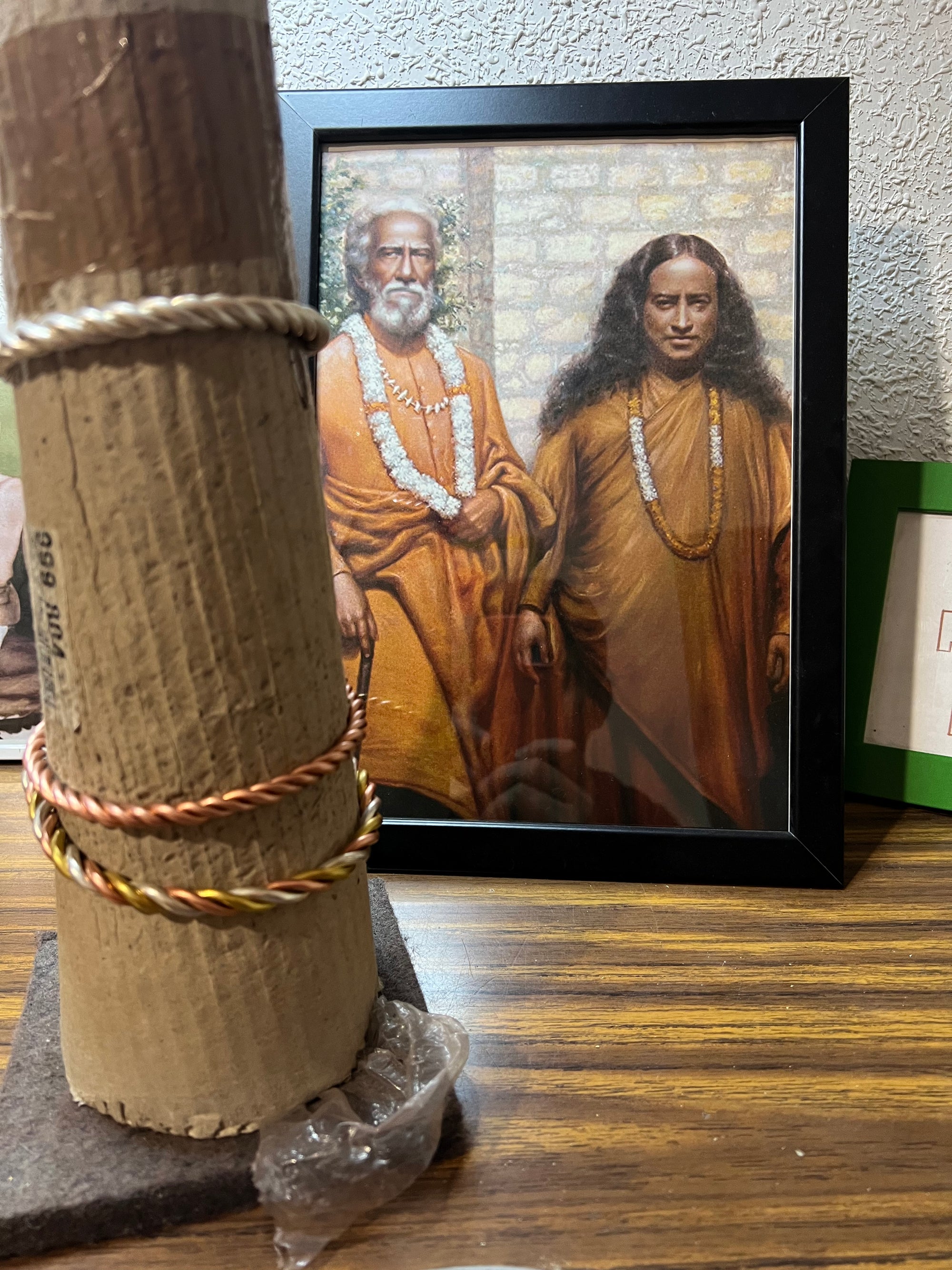
We could also focus attention solely on the ajña chakra or on an object (for example: our yoga bracelet).
4º) Move one bead, inhale again; then repeat.
...
5º) When you reach the end of the mala, you will have chanted 108 times; at that moment, put down the mala and make chi or jñana mudra.
6º) Remain in silence, open to the search, sensing the energy.
7º) At the end, make "pranam mudra" and recite "shanti" three times; lowering the head to the ground as a sign of humility.
OTHER CONSIDERATIONS
This exercise is more effective if practiced in a group, in a circle for example, as it mobilizes more energy.
It is recommended for the end of the session, after practicing asanas and pranayama.
Its duration is 30-40 minutes, so you may need to get used to sitting that long at first. The foundation of any exercise is consistency (it will improve over time).
For any questions about the practice, contact me. Have a good practice.
P.S.: Here is a good YouTube video to get started with "Om" using headphones and avoiding the need to count (autoplay disabled).
FOOTNOTES
*I am referring to the atman (the spirit trapped in the body, what we are and try to come to know) which is connected with Brahman (the real, eternal, and unchanging whole).
1 The Yoga Book, Swami Vishnu Devananda
2 Mandukya Upanishad
3 Hinduism’s key text
4 The Upanishads should end with "Shanti" (three times)
The image above is an artistic representation of the Sri Yantra.


Comment
Gracias por compartir.